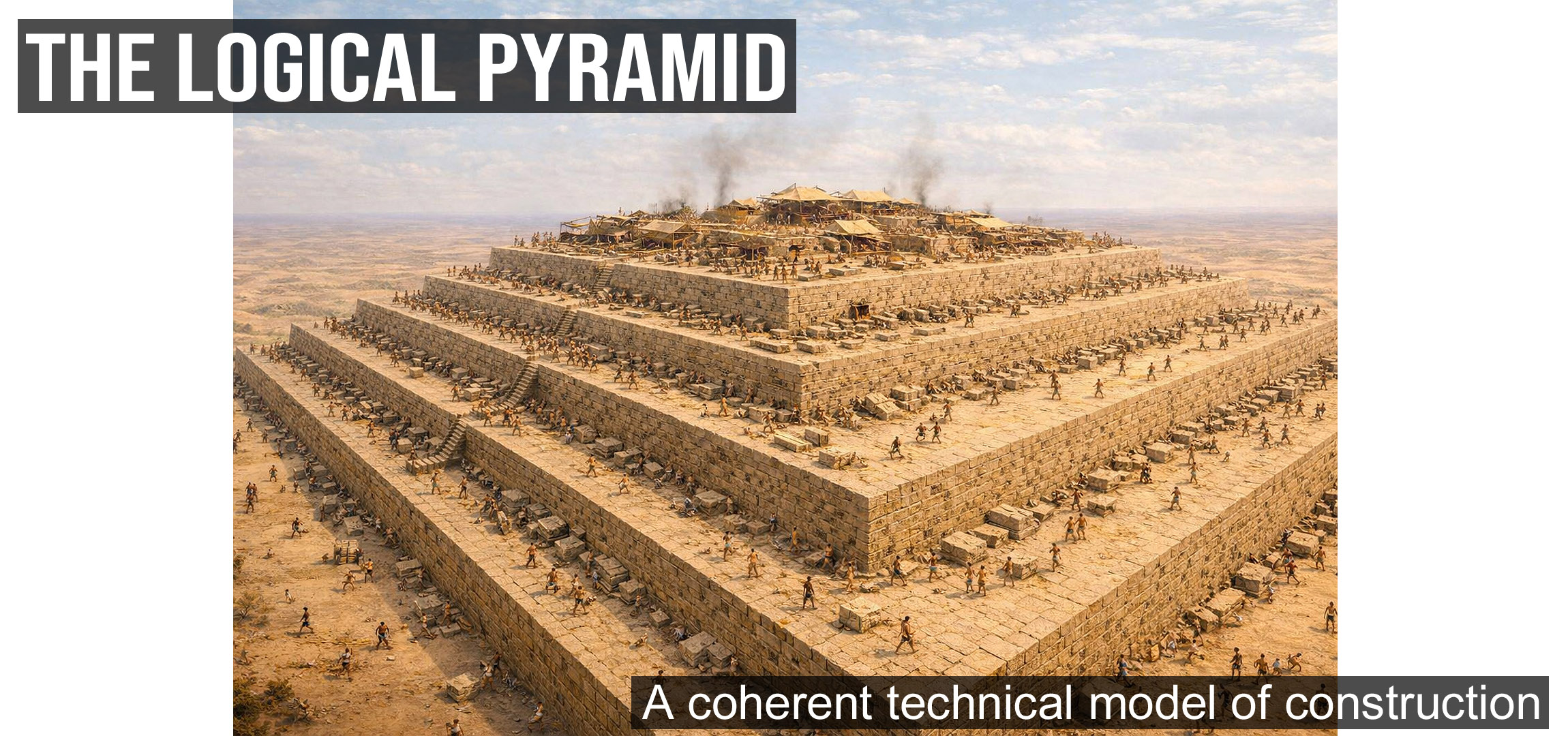
The construction of the Great Pyramid has been explained through numerous hypotheses. However, many of them reveal technical discontinuities when examined as a complete process.
The proposal developed in The Logical Pyramid is based on a fundamental premise:
the monument could have been built using a single coherent construction system, applied consistently from the initial stages to its completion, employing technical resources appropriate to its time and, above all, a rational organization of labor.
The process can be understood without resorting to large-scale external ramps or disproportionate mobilizations, but rather as the result of progressive planning integrated into the very geometry of the structure.
This reinterpretation does not only concern the general construction sequence; it also provides new insights into certain internal features of the monument and archaeological remains that have long been the subject of debate.
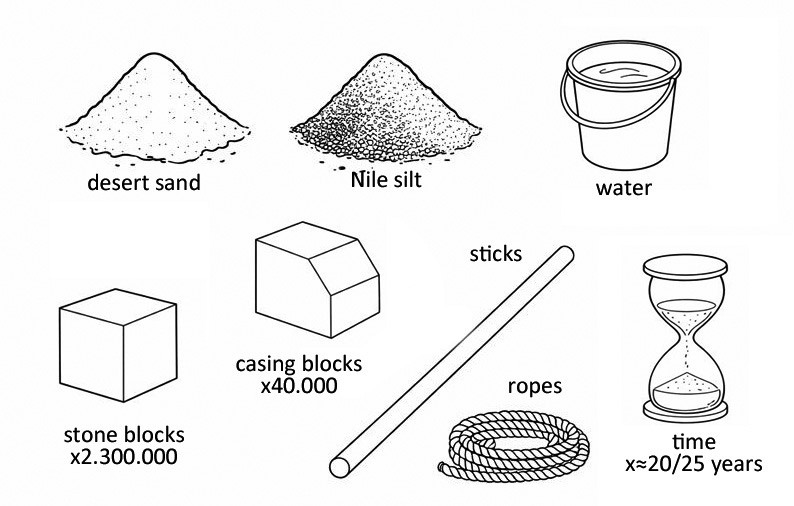 |
The magnitude of the project did not depend on sophisticated machinery, but on the systematic use of basic materials and simple tools, organized under a rigorous constructive logic.
If we accept that the system was continuous, organized, and progressive, an essential question arises:
What underlying logic made it possible to sustain that growth until the structure reached its final form?
 |
The complete development of the model and its detailed reconstruction are presented in the book
The Logical Pyramid.. The book examines step by step the progression of the construction process, its structural coherence, and the principles that support the hypothesis from the initial stages to the completion of the monument. Available on Amazon: [Spanish (Kindle/Paper back/Hardcover)] [English (Kindle/Paper back/Hardcover)] |
|